
Tariff Tactics
U.S. Customs and Border Protection (“CBP”) has launched its long-awaited Consolidated Administration and Processing of Entries (“CAPE”) portal, beginning Phase 1 of the International Emergency Economic Powers Act (“IEEPA”) tariff refund process. With CAPE now live, the focus shifts from litigation to an administrative claims process.
For importers, the practical question is simple: What do importers need to do? In short, to claim IEEPA tariff refunds, importers must submit eligible entries through CBP’s CAPE portal using Automated Commercial Environment (“ACE”) account data and supporting documentation. This post explains what importers need to do in more detail.
I. Which Entries Are Eligible for IEEPA Refunds Through CAPE?
CAPE is not an automatic refund system. It is a submission-and-review process.
As we previously explained in our March 17, 2026 post CAPE has four components: (1) a claims portal for ACE account holders to submit refund claims; (2) a mass processing module that recalculates duties; (3) a review and liquidation/reliquidation module; and (4) an electronic refund distribution process. Per a March 31, 2026 update, CBP has planned a phased rollout, though Phase 1 is projected to cover most IEEPA claims.
The entries eligible for refund in Phase 1 include unliquidated entries (including those for which liquidation has been suspended) and entries that have liquidated less than 80 days prior (essentially within the voluntary reliquidation window under 19 U.S.C. § 1501). Phase 1 will also include warehouse and warehouse withdrawal entries with declared IEEPA Chapter 99 codes and anti-dumping/countervailing duties (“AD/CVD”) under suspension (refunds might follow a liquidation timeline for these entries).
Certain entries are excluded from CAPE Phase 1, such as entries: (i) liquidated more than 80 days ago; (ii) with open protests; (iii) flagged for reconciliation (filed as Entry Type 09); (iv) with designated drawback claims; (v) subject to AD/CVD for which liquidation instructions are pending liquidation in accordance with 19 U.S.C. § 1504(d); or (vi) not filed in ACE. These entries may be accepted in later phases of CAPE. For example, we note that the CBP is required to “reliquidate[] without regard to the IEEPA duties” any “entries for which liquidation is final.” Euro-Notions Florida, Inc. v. United States, No. 25-00595, Order (Ct. Int’l Trade Mar. 27, 2026).
II. What Is a Customs Entry (and When Does It Liquidate)?
Phase 1 of CAPE will not accept finally liquidated entries or entries for which there is no ACE entry information. This section briefly summarizes liquidation timing and ACE entry issues depending on entry type as relevant to CAPE submission.
CBP enforces import regulations when goods arrive at a United States port of entry. Goods can arrive different ways, known as CBP entry types. This section focuses on “formal” and “informal” entry types. Other types—including postal, immediate transportation, transportation and exportation, temporary importation under bond, and foreign trade zone—typically have less relevance to IEEPA refund issues and are not considered here.
a. Formal Entries
Shipments valued at more than $2,500 require formal entry. In a formal entry, the importer posts a bond with CBP and pays estimated duties on imported merchandise. Formal entries also require submission of forms like CBP form 5106 (Request for Importer Number) and CBP Form 7501 (Entry Summary), resulting in entry data input into ACE.
After the estimated payment is made, there is a later liquidation date when the estimated payment is finalized. Liquidation must occur within one year of entry. 19 U.S.C. § 1504. The ACE system is set up to liquidate entries 314 days after entry, and this is the typical liquidation date. On liquidation, the importer either receives a refund or is further invoiced, depending on whether the estimated payment exceeds the liquidated amount.
b. Informal Entries
Informal entry applies to shipments valued at under $2,500. Historically, shipments under $800 in value were exempted from tariffs pursuant to the “de minimis” exemption. On May 2, 2025 the Administration eliminated the de minimis exception for goods from China and Hong Kong. As of August 29, 2025, the Administration eliminated the de minims exemption completely. But the informal entry procedure was not eliminated for import shipments valued under $2,500. With informal entries, there is no bond requirement, and the entry is liquidated upon payment of estimated tariff. There is no later liquidation date. Based on liquidation timing and/or lack of ACE entry data, some informal entries may be ineligible for CAPE Phase 1 claims.
III. How to Submit an IEEPA Refund Claim Through CAPE
To submit claims through the CAPE portal, importers must have access to an ACE account. Importers should go to the CBP’s ACE Secure Data Portal to ensure account access. Importers must also be enrolled for electronic refunds in ACE. Step by step instructions for enrolling can be found here. Per the discussion above, CAPE is not accepting informal entries, and these will require a different resolution process.
Next, importers must identify entries with Harmonized Tariff Schedule of the United States (“HTSUS”) IEEPA codes. Entries that do not have IEEPA HTSUS codes (9903.01.xx or 9903.02.xx) are not eligible for submission in this process.
Next, for those entries with IEEPA codes, importers must gather the entry numbers and dates, amount of IEEPA duties paid, and entry summary documents (for example, CBP Form 7501 or the equivalent.)
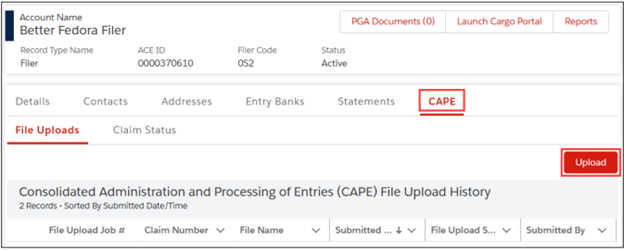
The data is submitted through a “Declaration.” Each Declaration can include up to 9,999 entries in a single declaration. To submit a Declaration an importer of record must upload a comma separated value file and certify to the accuracy of the contents, as shown below:

Once submitted, the claim is assigned a number and processed, as shown below:

Importers should note that the Declaration cannot be amended post submission. Therefore, it is critical that importers submit accurate declarations to ensure timely processing of refunds. Importers can find updated information from the CBP on submission of claims here, and detailed step by step instructions, published on April 20, 2026 here.
IV. When Will Importers Receive IEEPA Refunds? (Timing & Processing)
importers should be aware that CBP can apply any IEEPA refund amount “to offset amounts owed with respect to other duties.” Euro-Notions Florida, Inc. v. United States, No. 25-00595, Order at 1 (Ct. Int’l Trade Apr. 14, 2026). Most importers might receive a “refund” in the form of netting out against other duties owed. Moreover, CBP can divert refunds to pay uncontested amounts owed to the government. This would appear on a REV-615, Trade CAPE Detail Refund Report, in a column labeled “Refund Secondary Status” with the notation “Funds Diverted.” In considering refund timing, importers should note the possibility of a refund netted out against other duties or monies owed.
With that context, for Phase 1 eligible entries, CBP has estimated that importers will receive refunds in 60 – 90 days from the date of the acceptance of a Declaration in the CAPE portal. However, there are possible errors that may delay refund. We have prepared the summary guide below for CAPE acceptance and error codes, based on CSMS #68340863 and other live reports since the CAPE portal launch:
|
Code |
Meaning |
|
ENTRY SUMMARY UPDATED |
This is good and indicates a refund within 60-90 days. |
|
UNABLE TO CALCULATE DUTY (suspended/extended) |
If the entry is suspended or extended, this means the refund will issue pursuant to liquidation timelines. |
|
UNABLE TO CALCULATE DUTY (zero-duty conflict) |
This is likely a filing error involving Section 232 duty lines and IEEPA lines causing an unresolved ambiguity in ACE |
|
UNABLE TO CALCULATE DUTY (Unknown) |
Some non-extended/suspended entries with correct IEEPA codes are generating this error. An Importer of Record or Customs Broker can email IEEPARefunds@cbp.dhs.gov, identifying the entry number for resolution |
|
FINAL LIQUIDATION STATUS |
This Declaration contains entries that liquidated more than 80 days ago and are ineligible for Phase 1 (you may need to protest) |
|
NO IEEPA HITS ON ENTRY (No IEEPA duties) |
The submission doesn’t have 9903.01.xx or 9903.02.xx HTS Codes because there are no IEEPA duties and it’s not eligible for CAPE refund. |
|
NO IEEPA HITS ON ENTRY (Misfiled HTS code) |
The entries were filed without ten-digit HTS codes (e.g. filed as FREE). The broker will need to address this classification issue. |
|
PROCESSING NOT COMPLETE |
The duty payment cycle is still processing in ACE or there is a pending Post-Summary Correction. This can likely be resolved by resubmitting |
|
ENTRY ON DRAWBACK |
The entry or entries have active duty drawback claims and are not eligible for Phase 1 processing in CAPE |
|
ACCOUNT MISMATCH |
There is a mismatch between the claimant and the Importer of Record name. The claimant should check their name against Form 7501 to resolve the issue |
|
JMS processing, exception, 504, etc. |
These are infrastructure/server errors and resubmission after a day could rectify the issue |
Assuming that entries on a Declaration are processed without the errors noted above, then the refund timeline is likely two to three months (sixty to ninety days) from submission. Otherwise, for errors that can be rectified, as noted above it is sixty to ninety days from acceptance of the Declaration.
V. Conclusion
CAPE’s launch marks a significant development: IEEPA refunds went from theoretical to operational. Importers should: (1) ensure that their ACE account and payment system is properly setup; (2) review entries for IEEPA data; (3) prepare entry data submissions; (4) submit eligible entries through CAPE; and (5) rectify potential errors by resubmission or correction as noted above.
 Partner
Siddartha Rao is a commercial litigator who has represented clients ranging from small businesses and individuals to large corporations. His practice experience includes litigation in Federal and State trial and appellate ...
Search Blog

Recent Posts
- CAPE Is Live: How Importers Can Claim IEEPA Tariff Refunds Now
- CIT Signals “Be Aware”: Preserving IEEPA Refund Rights Amid Atmus Filtration Stay and Ongoing Liquidation
- After Atmus Filtration: What Importers Should Know About IEEPA Liquidation, Protests, and New Section 301 Tariffs
- Atmus Filtration: What a Liquidation-Based IEEPA Refund Process Means for Importers
- IEEPA Tariffs Invalidated — Refund Questions Likely Move to the Lower Courts
- What Importers Can Do if the Supreme Court Invalidates IEEPA Tariffs
- Decision Day Approaches on IEEPA: A Final Resolution or a New Chapter?
- Protecting IEEPA Tariff Refund Rights Pending Supreme Court Review: What Importers Should Do
- Liquidation Without Injunction: What the CIT’s AGS Ruling Means for IEEPA Tariff Refunds
- Costco Sues Over IEEPA Tariffs — What This Means for Importers Seeking Refunds